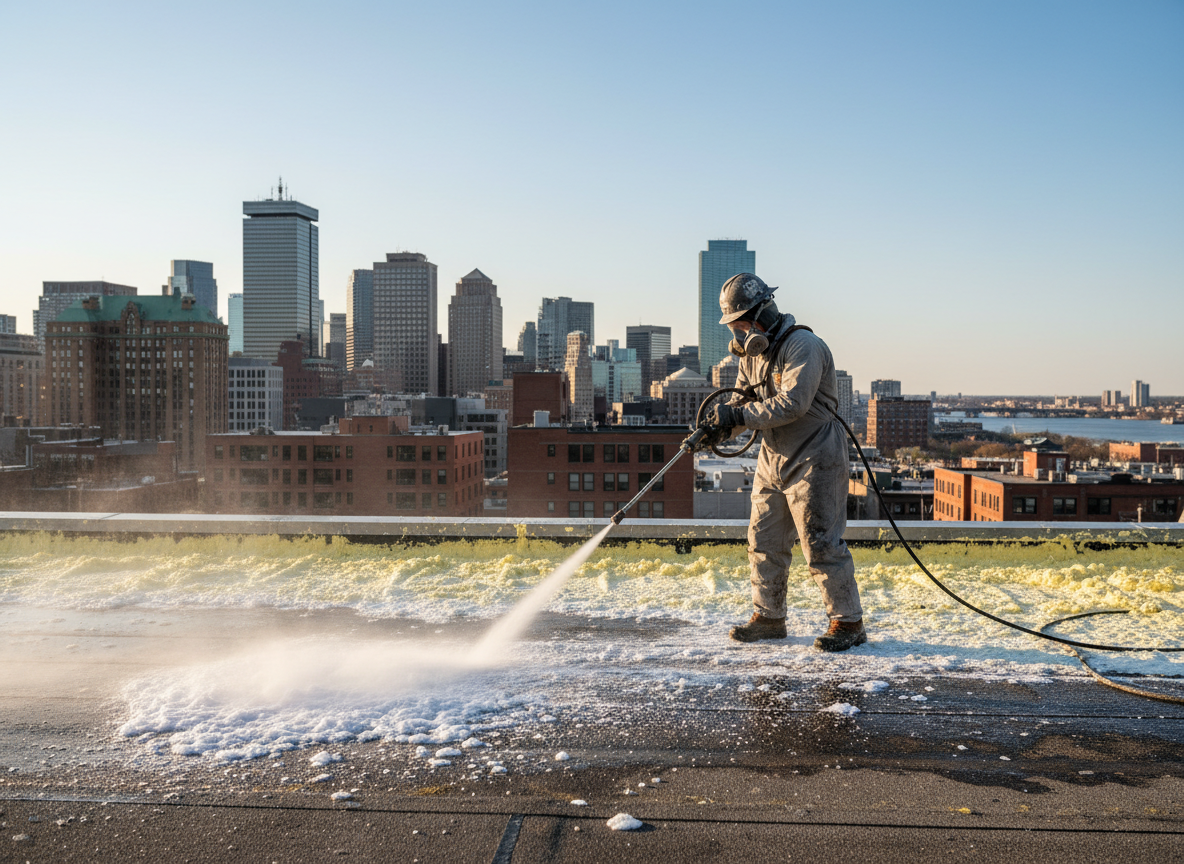
Roof spray foam removal in Boston properties often involves older pitched roofs where closed-cell foam was applied directly over original felt or slate. Over time this traps condensation against timbers, especially in the narrow streets around Strait Bargate where airflow is restricted. Careful mechanical scraping followed by solvent treatment prevents damage to underlying battens and allows inspection of rafters for rot that commonly develops in Lincolnshire's damp winters.
Edge cases include foam that has expanded into eaves and behind fascia boards on semi-detached houses common in the Boston area. These sections require sectional dismantling rather than full roof strip to avoid disturbing adjacent properties. Local building control may require notification when foam removal exposes insulation changes, and waste must be bagged for licensed disposal rather than left on site.
Homeowners sometimes attempt DIY steam removal which softens foam unevenly and leaves residue that re-adheres during warmer months. Professional teams use staged low-pressure removal combined with HEPA vacuuming to capture particulates before they settle into loft insulation below. This approach protects electrical wiring and pipework that runs through many pre-war Boston roofs.
Weather plays a direct role: summer work allows faster curing of any replacement coatings, while winter jobs demand temporary sheeting to keep rain off exposed timbers during multi-day extractions typical on larger Victorian terraces.
Technician insight
In Boston the thing that catches most people out with roof spray foam removal is the way older slate roofs around Strait Bargate trap moisture once the foam breaks down, especially where properties back onto the river and get less sun. Homeowners often miss the early staining on ceiling joists until it spreads.
Foam removal on terraced roof near Strait Bargate
Foam on a Victorian terrace had begun to delaminate and hold water against the felt. Inspection showed rot starting along the eaves shared with the neighbour. We stripped the foam in sections, treated the timber, and fitted new ventilation strips before re-securing the slates. The loft stayed dry through the following winter.
How it works
- 1
Site Assessment
Inspect roof structure, foam thickness and access points from Strait Bargate base before scheduling.
- 2
Containment Setup
Install sheeting and negative pressure zones to protect interiors and neighbouring properties during removal.
- 3
Foam Extraction
Use mechanical and chemical methods to strip foam without damaging original roof coverings.
- 4
Timber Inspection and Cleanup
Check rafters for moisture damage, vacuum residues and remove all waste from site.
- 5
Final Verification
Walkthrough with homeowner to confirm clean roof void and discuss any follow-up ventilation needs.
Pricing
Costs depend on roof size, foam depth and access difficulty; upfront quotes provided after inspection.