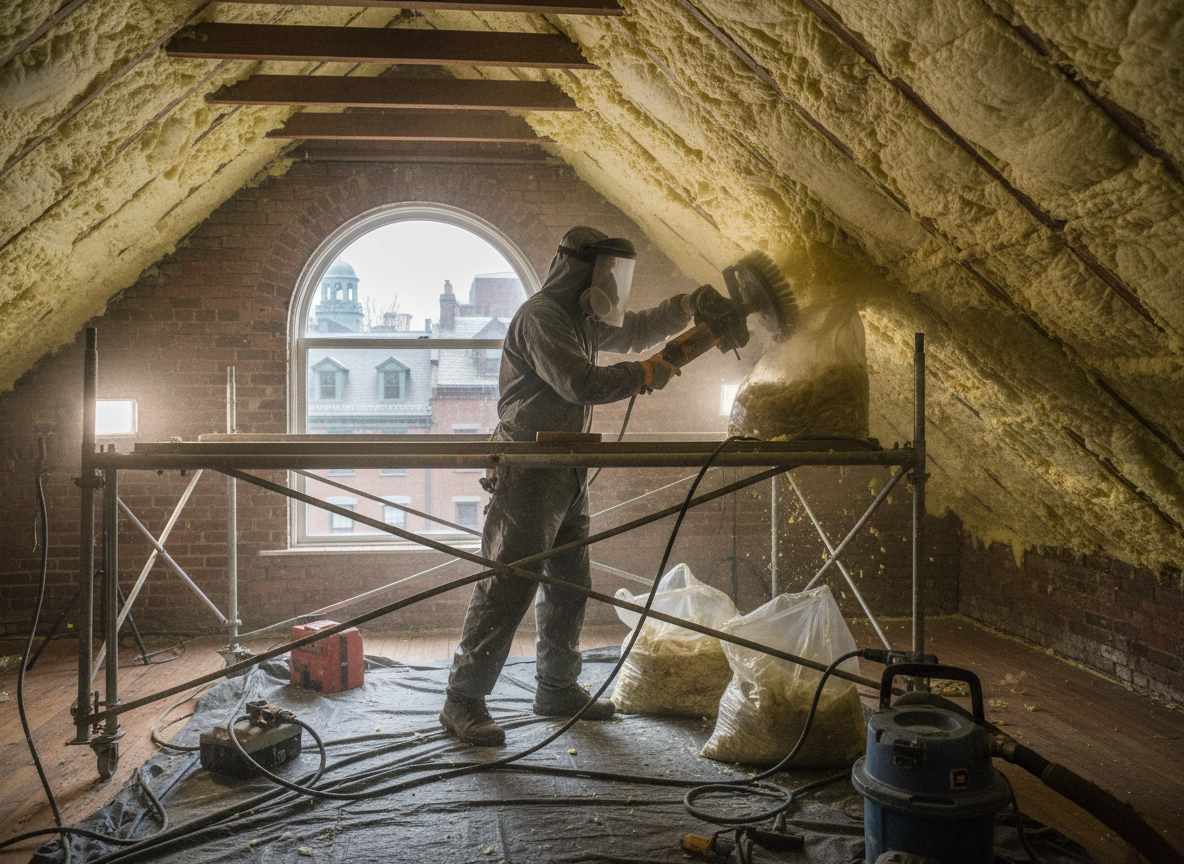
Boston's older housing stock, particularly Victorian terraces and Edwardian semis around the town centre and Skirbeck, often received spray foam in lofts during the 2000s energy schemes. The closed-cell polyurethane bonds tightly to joists and lathe, trapping moisture against timber that already faces high winter humidity from the nearby Wash. Removal requires cutting back in sections rather than pulling, to avoid cracking aged ceiling plaster below. Homeowners frequently discover hidden water staining only once the foam is gone.
Lincolnshire's flat terrain and occasional flooding in low-lying parts of Boston mean lofts can stay damp for weeks after heavy rain. Foam that was applied over existing mineral wool or between rafters leaves residue that must be scraped and vacuumed before any new insulation goes in. Electrical cables and old water tanks hidden under the foam need checking for corrosion, as the material's expansion can press against them over years.
Local planning rules in conservation areas around Boston require care not to disturb original roof structures during removal. ClearSeal Solutions works from Strait Bargate and covers the full PE21 postcode plus nearby villages, arriving with negative-air machines to control dust that would otherwise settle through floorboards into living spaces below.
After foam is cleared, ventilation gaps at eaves and ridge must be restored to prevent condensation returning. Many Boston lofts also contain old water tanks or pipework that the original installers covered; these are inspected and left accessible rather than re-covered.
Technician insight
In Boston, the thing that catches most people out with loft spray foam removal is how many 19th-century joists around the market place and in Skirbeck have already been stressed by decades of trapped moisture; the foam hides the rot until we start cutting, and a quick pull risks dropping ceiling plaster into the rooms below.
Skirbeck Terrace Loft
Homeowner in a Skirbeck terrace reported musty smells and cold spots. Inspection showed closed-cell foam fully covering original rafters and an old water tank. We cut the foam in sections, cleared residue, confirmed the tank was sound, and restored eaves ventilation. The loft now dries properly between the area's damp winters.
How it works
- 1
Site Inspection
Assess foam depth, joist condition, electrical runs and any hidden tanks from the access hatch in Boston lofts.
- 2
Containment Setup
Seal the loft hatch and install dust extraction to stop particles drifting into rooms below.
- 3
Sectional Removal
Cut foam into manageable pieces, working around rafters and avoiding damage to historic timbers common in the area.
- 4
Surface Cleaning
Scrape residue, vacuum thoroughly and check for moisture or corrosion before handing back the space.
- 5
Ventilation Check
Confirm eaves and ridge vents are clear so the loft can breathe after the work.
Pricing
Pricing depends on loft size, foam thickness and access difficulty; upfront quotes provided after inspection.